Whole Foods Market has unveiled its new rating system called Responsibly Grown for fruits, vegetables and flowers. This system rates produce as “Good” “Better” or “Best”. You would think that fruits and vegetables with the “best” rating would mean just that…..the highest quality.
That was not the case, this S222pring, at a Whole Foods Market store in California. Organic asparagus, grown in California, carried the green “good” label while conventionally grown asparagus from Mexico received the gold “best” label in these photos below from The Cornucopia Institute article:
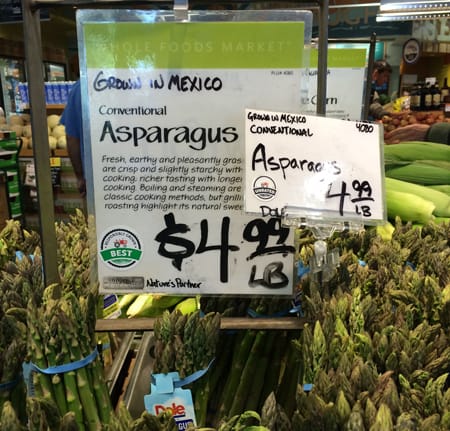
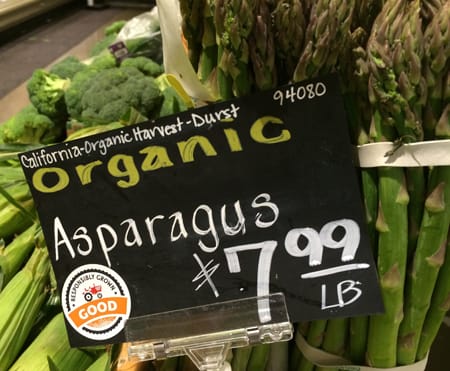
Mark Kastel, co-founder and Senior Farm Policy Analyst at Cornucopia asks, “Why would a customer pay three dollars more per pound for the Certified Organic asparagus when they could buy what a trusted retailer has labeled ‘Best’?”
The Rating System
The rating system takes in to account soil health, farm worker welfare, ecosystems, biodiversity and much more according to Whole Foods website. The use of pesticides is not a deal breaker in the new rating system – even conventionally grown produce can receive a “best” label which can be misleading to shoppers who assume that best means healthy, quality produce.
Certified Organic farmers think that the “best” label should be reserved for organic produce.
The rating system does ban certain pesticides but others are allowed as discussed here in the Cornucopia Institute blog from 6/12/15.
Organic Farmers Express Concern
Understandably, Certified Organic farmers are upset about the new labeling system and have drafted and sent a letter to John Mackey, CEO of Whole Foods. The letter is signed by many well respected farms and organizations across the country. Mark Kastel, co-founder of the Cornucopia Institute, points out that Whole Foods has always concerned itself with promoting organic foods and yet now this program is “attempting to put some of this conventional food on a pedestal higher than organic. He feels that this new system is a “self serving program to help their (Whole Foods) marketing”.
Whole Foods is asking growers to pay for the program that could result in their farms being included in their new rating system.
In their letter to Mackey, the authors write that the cost of the program to farmers can range anywhere from $5,000 to $20,000 which will prevent small and even medium sized farms from participating. You can read the letter here.
This situation reminds us that as consumers we have to read ALL labels at the grocery store, including the produce section.
As a health conscious consumer I want to avoid pesticides in the produce and the meats I buy. The Environmental Working Group’s 2015 Dirty Dozen/Clean Fifteen Guide lists the fruits and vegetables that are the most and the least contaminated with pesticide residue. Use it to help make smart choices no matter what the new rating system at Whole Foods might say!
photo credit The Cornucopia Institute